
Water-Damaged Particle-Board Flooring
Why We Almost Always Replace It
From Aries Builders — forensic leak and water-damage specialists, Auckland, since 1988
What decades of coming back has taught us
Over the years we've been called back to a lot of floors that someone else dried out and left in place. The pattern is nearly always the same. At the time, the particle-board looked fine. It had dried out, it felt firm underfoot, and everyone moved on. Then months — sometimes years — later, we're back at the same house, and that same area has gone soft. It's pushed down between the joists, dipped where people walk, and started to fail.
It shows up most in the busy parts of a home: hallways, and the kitchen — especially the run of floor around the kitchen benches. Those are the areas that take the most foot traffic, and they're the ones that seem to give way first once the board has been wet.
So we've reached a simple position, and it comes straight from having to go back and do these repairs twice:
if we know an area of particle-board flooring has been wet, we recommend replacing it. Even when it's dried out. Even when it feels solid the day we're standing on it. We'd rather replace it once, properly, than dry it, close it up, and have the homeowner living on a floor that's quietly failing underneath them.
That's our experience talking. As it turns out, the building science and the New Zealand rules back it up — so here's the
why behind the recommendation.
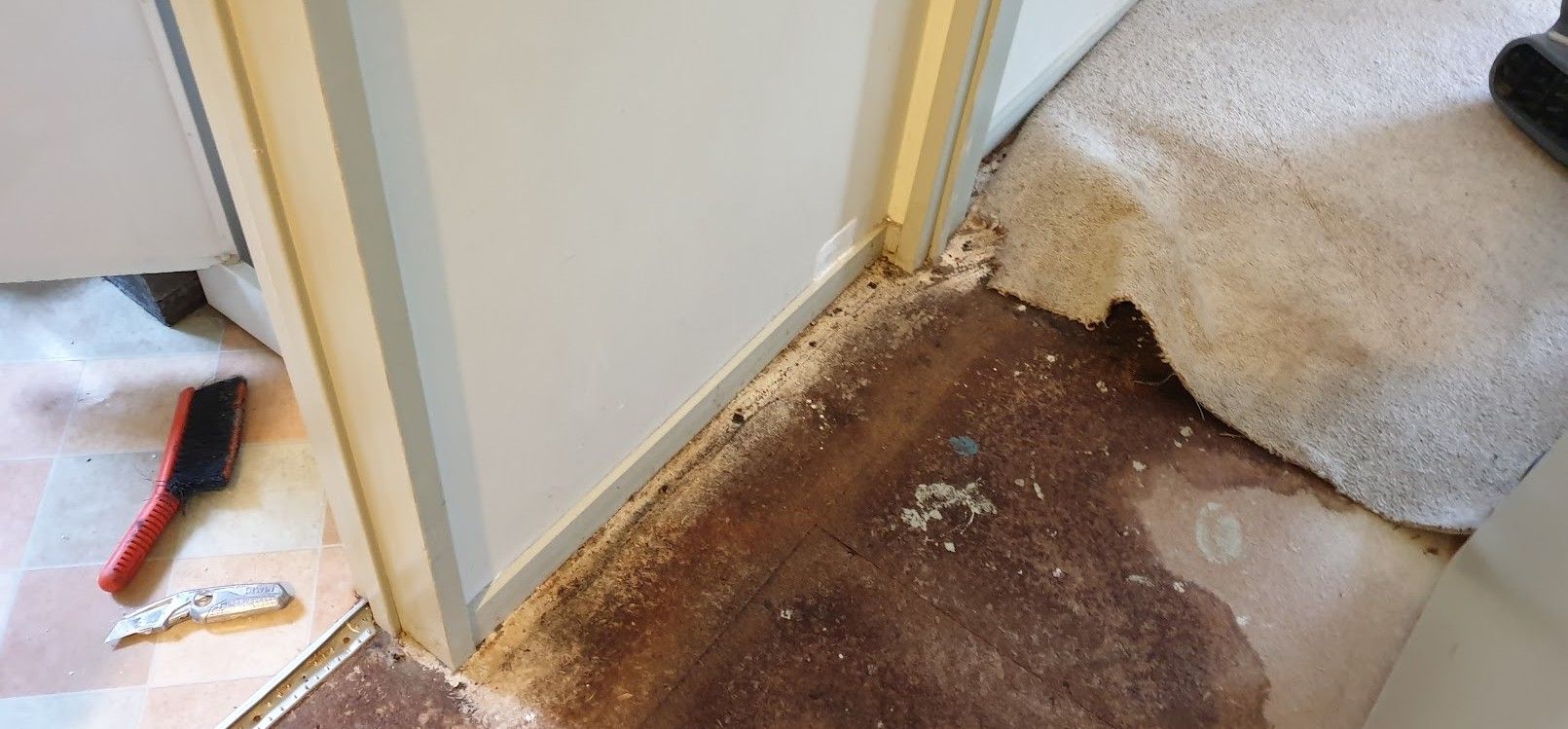
What particle-board flooring actually is
Particle-board flooring is made from wood off-cuts, sawdust and shavings, mixed with a resin glue and pressed under heat into big sheets. Builders have used it for decades because it's cheap, fast to lay, and gives a nice smooth base for carpet or vinyl.
Its strength doesn't come from the wood — it comes from the
glue holding all those little particles together. That's the key thing to understand, because it's exactly what water attacks.
How it's bonded — and why "moisture-resistant" isn't waterproof. Older boards were glued with urea-formaldehyde (UF) resin and given a thin wax coating to slow water soaking in. Newer "moisture-resistant" (MR) boards use a tougher melamine-urea-formaldehyde (MUF) glue with wax mixed right through the sheet. MR board copes better with the odd splash and with normal building conditions — but it is
not waterproof. It buys you time, not immunity. Sit either type in water long enough and it will still fail.
Concerned About Your Particle Board Flooring?
If you’re in Auckland and would like us to take a look, Aries Builders can inspect the area, discuss the best repair options and provide a quote.
Book a free site visit
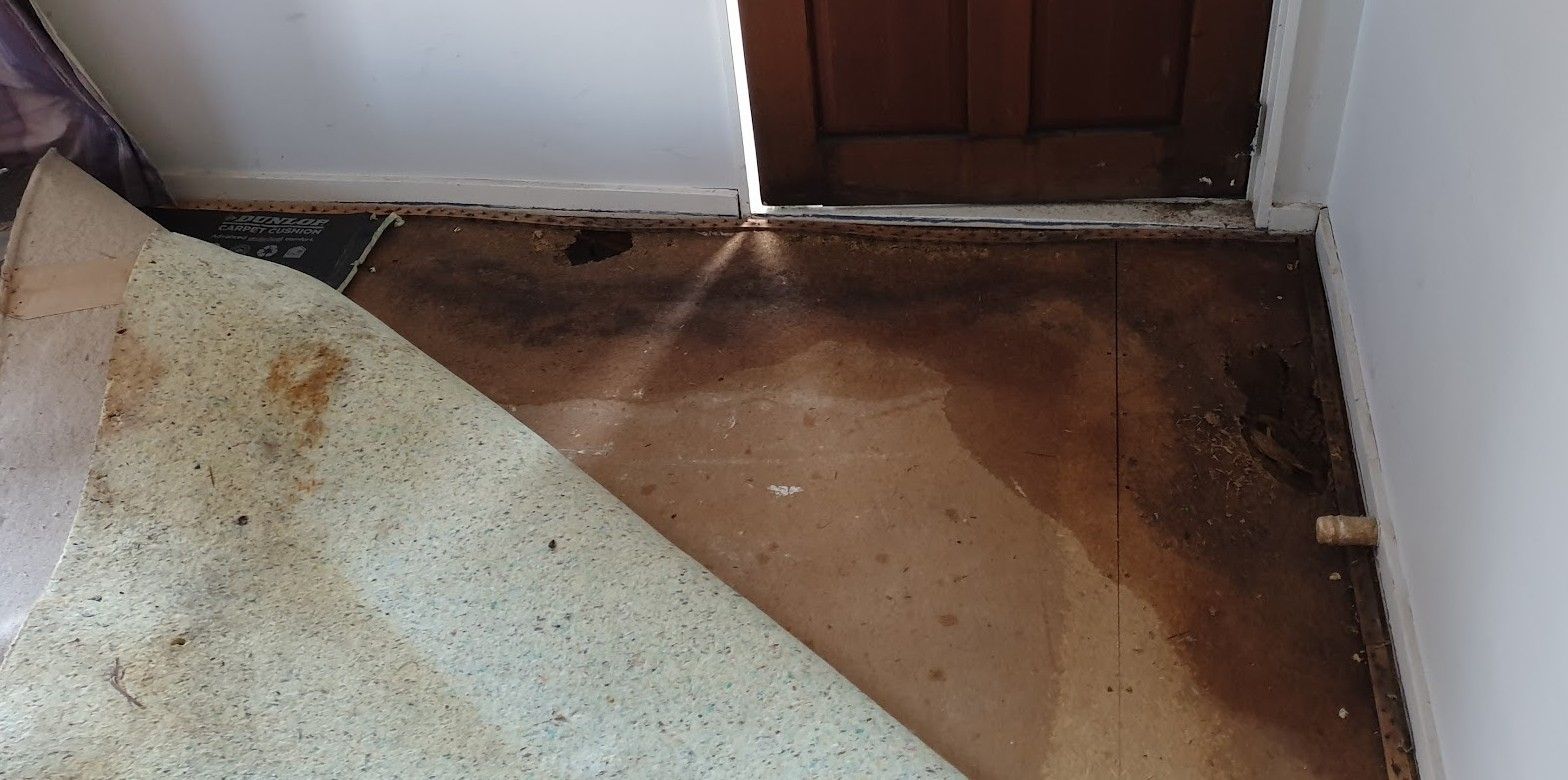
What water actually does to it
When particle-board gets soaked, two things happen at once. The water softens the resin that's doing all the holding, and the wood particles themselves swell up. The board expands, loses its stiffness, and starts to lose the structural strength it relied on. Even small nail or screw holes give water a way in and speed the whole thing up.
Here's the part that catches people out — and it's the reason we're so firm about replacing:
Particle-board can look and feel dry on top while it's still wet, and still failing, underneath. After a flood or a leak, the surface can seem solid while moisture is still trapped inside the sheet — and the real weakening keeps going quietly for months, often only showing up once carpet or vinyl has been laid back over the top and there's no way to see it. By the time the floor feels spongy or dips, the damage is well and truly done, and now it's under a finished floor.
Why a moisture reading on its own isn't enough
We use calibrated moisture meters on every job — they're a core part of how we diagnose. But we've learned not to let a single dry-looking reading make the decision on particle-board, and there's a good reason for that: moisture meters can read inaccurately in particle-board. The way the board is made can give you a number that looks reassuring while moisture is still sitting deeper in the sheet. To be truly certain a board is dry, you're often looking at oven-dry testing or, where there's real doubt about strength, a structural engineer's assessment.
That's why our recommendation isn't "test it and hope." It's: if the area has been genuinely wet, take the doubt off the table and replace it.
What the New Zealand rules say
This isn't just our opinion — the standards point the same way.
Under NZS 3602 (which sits behind the Building Code's durability requirements), floors in
wet areas — bathrooms, kitchens, laundries and toilets — have to be protected by an impervious, watertight surface. And where you can't
guarantee that surface will be kept up over time, the flooring is required to be treated plywood or treated timber —
not particle-board.
The rules got firmer in November 2020. Under the current wet-area membrane requirements,
flooring-grade particle-board is no longer permitted as a new substrate in any wet area at all. The recommended material is H3-treated plywood. There's a specific warning, too, about the areas under baths and showers: considerable
undetected water damage can build up there, in the board and the framing around it, which is exactly why treated plywood is called for.
In plain terms: for new wet-area floors, the direction of travel is away from particle-board entirely. So when we're repairing a water-damaged floor, replacing failed particle-board with the right material isn't us gold-plating the job — it's bringing the floor up to where the standards now sit.
When we recommend replacing
We'll always recommend replacement when we see any of these:
High moisture content (readings above roughly 18%), or a board that's been sitting wet for an extended period.- Visible swelling at the sheet joints, soft or springy spots underfoot, delamination, or crumbling edges.
- Mould, or a persistent musty smell — a sign moisture has been there long enough to take hold.
- A warm-water leak — for example a burst hot-water cylinder. Heat speeds up the breakdown of the glue, so warm-water damage is often worse than it looks.
And underlying all of that: if we know the area has been wet and it's in a high-traffic spot like a hallway or around kitchen benches, our experience says replace it, because that's where we've had to come back.
When it can sometimes stay
We believe in being straight with people, so here's the honest other side. Not every wet board is a write-off.
If particle-board has only been
briefly wet, dried out
quickly, and moisture testing confirms it's back within a few percent of the surrounding, undamaged flooring, it may be able to stay. In that case the right approach is screw-fixing it back down and sanding off any swelling at the edges before anything goes back over the top. Where there's genuine doubt about how much strength is left, that's when a structural engineer should take a look.
The deciding factor is always the same:
how wet, for how long, and can we prove it's truly recovered — not just dry on the surface.
How we approach a water-damaged floor
When we're called to water damage, we don't guess and we don't rush to close things up. We test to find how far the water actually travelled, we document the damage properly before anything is stripped out or dried (which also protects your insurance claim), and we give you a clear, honest scope: what can stay, what needs to go, and why. Then we rebuild it once, with the right materials, so you're not living on a floor that's failing where you can't see it.
That diagnose-first approach is the whole reason clients call us for the tricky ones — and it's why, when it comes to wet particle-board, we'd rather do it once and do it right.
Frequently asked questions
Does particle-board flooring always need to be replaced after water damage? Not in every single case, but often — and in our experience, usually. If it's only been briefly wet, dried out fast, and testing confirms it's genuinely recovered, it can sometimes stay. But if it's been saturated, wet for a while, or it's in a high-traffic area like a hallway or around kitchen benches, we recommend replacing it. We've been called back too many times to floors that were dried and left in place, only to find them soft and failing months later.
Can water-damaged particle-board just be dried out and saved? Sometimes, but drying alone doesn't undo the damage. Water softens the glue holding the board together and swells the wood particles, and that loss of strength doesn't fully reverse just because the board dries. A board can feel firm again on top while it's weakened inside. That's why we test properly and, where there's doubt, replace rather than risk it.
Why does particle-board go soft months after it dried out? Because the sheet can hold trapped moisture inside even when the surface feels dry, and the weakening keeps going quietly underneath — often hidden once carpet or vinyl is laid back over it. The failure tends to show up later as soft spots or dips, especially in areas that get a lot of foot traffic. This time-lag is exactly why we're cautious about keeping wet boards.
Can I trust a moisture meter reading that says it's dry? Not on its own for particle-board. Moisture meters are a valuable tool and we use them on every job, but the way particle-board is made can produce a reading that looks dry while moisture is still deeper in the sheet. To be truly certain, oven-dry testing or a structural assessment may be needed. We don't let a single reassuring reading make the whole decision.
Is particle-board allowed in bathrooms and kitchens in New Zealand? Wet-area floors have to be protected by a watertight, impervious surface, and where that upkeep can't be assured the standards require treated plywood or timber rather than particle-board. Since November 2020, flooring-grade particle-board isn't permitted as a new substrate in any wet area. So for new wet-area work the answer is effectively no — treated plywood is the way to go.
What's the difference between standard and moisture-resistant (MR) particle-board? Standard board uses a urea-formaldehyde glue with a surface wax coating. Moisture-resistant (MR) board uses a tougher melamine-urea-formaldehyde glue with wax distributed through the whole sheet, so it copes better with construction moisture and the occasional splash. But MR board is still not waterproof — given enough time in water, it will still fail.
What should I use instead of particle-board in a wet area? H3-treated plywood is the recommended material for wet-area floors, with the whole floor properly waterproofed. It stands up to occasional wetting far better than particle-board and is what the current standards point to. When we replace failed particle-board, we use the right material for where it's going.
Worried about a water-damaged floor, or dealing with an insurance repair? We investigate properly before we recommend anything.
Get in touch with Aries Builders
— Auckland, since 1988.
Water Ingress? We Can Find It and Fix It.
Aries Builders specialises in investigating and diagnosing water ingress and moisture problems throughout Auckland.
Using moisture meters, infrared thermal imaging and years of practical building experience, we can help identify where the water is coming from and what damage may have occurred.
We can then provide a clear scope of work and quote for the repairs required.
We find the problem. We explain the problem. We fix the problem.