
The Bedroom Ceiling Leak That Didn’t Want to Be Found
An Auckland homeowner had roofers and plumbers trying to find a mysterious bedroom ceiling leak. The real cause was something nobody expected.

By the time this homeowner contacted Aries Builders, they'd had enough.
A mysterious water stain had appeared on their bedroom ceiling. The paint was bubbling, peeling and turning brown. And the damage was getting worse.
They'd already had roofers out. They'd had plumbers out.
Everyone had a look. Everyone had a theory. But nobody could find where the water was coming from.
The strange thing was that there was no obvious reason for water to be entering the bedroom.
And every week, the ceiling continued deteriorating.
First suspect: the roof
When you discover water coming through your bedroom ceiling, the first thing you suspect is a leaking roof.
And that's exactly where we started.
We inspected the roof, looking for damaged roofing materials, failed flashings or anything else that could allow rainwater inside.
But the roof appeared to be in good condition.
Back inside the bedroom, we checked the ceiling using our moisture meter.
It was saturated.
What made this particularly unusual was that there was no plumbing anywhere near the affected bedroom ceiling.
No pipes. No hot water cylinder. No obvious source of water.
A wet bedroom ceiling, a roof that appeared sound and no plumbing above it.
Something wasn't adding up.
Time to squeeze into the roof space

There was only one way to get to the bottom of this mystery.
Up into the roof space.
Now, I'll be honest. This particular roof space wasn't designed with someone my size in mind.
I managed to take a photo of myself squeezed between the roof and ceiling.
All you can really see is one eyeball.
That's how tight it was!
But sometimes finding a leak means getting into the places nobody particularly wants to go.
Following the evidence above the bedroom
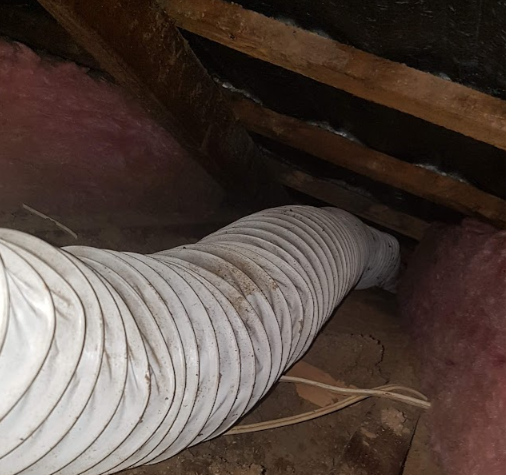
Once inside the roof space, I noticed a flexible duct running across the ceiling.
It was the white, ribbed plastic hose connected to the bathroom extractor fan .
The extractor fan was designed to remove warm, steamy air from the bathroom and discharge it outside.
But the ducting travelled across the roof space, passing above the bedroom.
Instead of running in a reasonably straight line, it dipped between the ceiling trusses, then rose again before dropping towards the soffit outlet.
That caught my attention.
I followed the ducting along to its lowest point.
And there it was.
The hose had split open.
The metal spiral wire that held the flexible hose in shape had rusted through, broken apart and pushed through the plastic ducting.
And directly underneath?
The water-damaged bedroom ceiling.
I found the source.

How could a bathroom extractor cause a leak in the bedroom?
This was the interesting part.
The water wasn't coming from the roof. It wasn't coming from the plumbing. It was coming from the family's showers in a completely different room.
Every time somebody had a hot shower, the bathroom extractor fan pulled warm, humid air out of the bathroom and through the flexible ducting towards the outside of the house.
But the ducting passed through a cold roof space above the bedroom.
As the warm, moisture-filled air travelled through the cold duct, some of that moisture condensed into liquid water.
Because the duct was sagging between the trusses and ceiling, the condensation collected at its lowest point.
Shower after shower, month after month, water continued accumulating inside the hose.
The evidence suggested that prolonged exposure to trapped condensation had corroded the spiral wire, which then broke and punctured the plastic duct.
Now, instead of the condensation being contained inside the ducting, it was escaping directly above the bedroom ceiling.
Every time the family used the shower, more moisture could collect and leak through the damaged duct.
A bathroom ventilation problem was creating what looked exactly like a roof leak in the bedroom.
No wonder the homeowners had been struggling to find it.
What we discovered underneath
The evidence was sitting directly below the broken ducting.
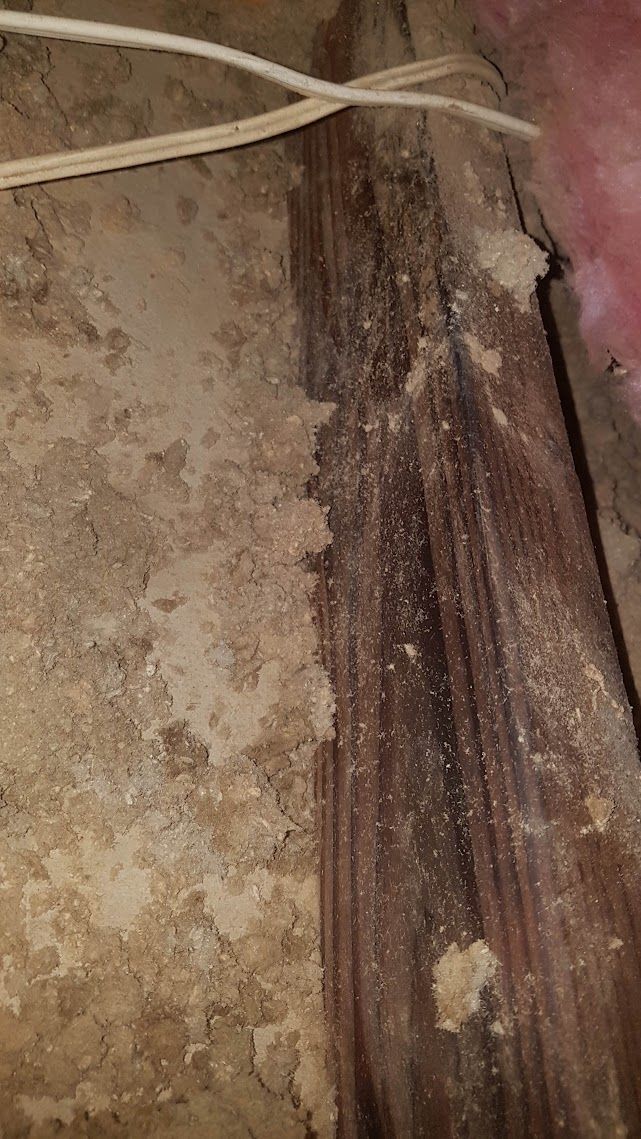
The loose-fill ceiling insulation, commonly known as Insulfluff, had absorbed the leaking water.
It had become compacted, hard and cracked, almost like dried mud.
The nearby timber ceiling trusse was also visibly water-stained.
The damage had been happening quietly, hidden above the bedroom ceiling.
And because the bedroom was nowhere near the shower itself, nobody had thought to suspect the bathroom extractor fan.

A simple problem that was surprisingly difficult to find
After roofers and plumbers had tried to identify the mysterious bedroom leak, the culprit turned out to be a sagging section of bathroom extractor ducting.
The cause was relatively simple.
Finding it was the hard part.
The damaged ducting needed replacing, with the replacement correctly supported and routed to prevent condensation from collecting.
The affected ceiling, insulation and timber also needed assessing before reinstatement.
And here's the important lesson.
If the homeowners had continued looking for a roof leak, they could have spent thousands repairing a roof that wasn't causing the problem.
Meanwhile, the bedroom ceiling would have continued getting wetter.
That's why finding the source of a leak is just as important as repairing the damage it causes.
What homeowners can learn from this
- A ceiling leak doesn't always come from directly above. Water can travel from another room or along building components before becoming visible.
- Your bathroom extractor can cause water damage elsewhere in the house. Particularly when ducting passes through cold roof spaces and isn't installed correctly.
- Sagging extractor ducting can collect condensation. Water trapped inside flexible ducting can eventually cause deterioration and leaks.
- A working extractor fan doesn't guarantee the ducting is working properly. The fan may continue running even when the ducting has split or become disconnected.
- Investigate the source before paying for repairs. Otherwise, you risk spending money fixing something that was never the problem.
The building science: how extractor ducting becomes a hidden water trap
A bathroom extractor fan carries warm, moisture-laden air outside. When that air passes through ducting in a cold roof space, the inside surface of the duct can be cold enough for water vapour to turn into liquid droplets.
This happens when the surface temperature falls below the air’s dew point—the temperature at which condensation begins. It is the same principle that causes a bathroom mirror to mist up. Condensation can form along several cold sections of duct, rather than at just one spot.
Why the down–up–down route caused a problem
In the arrangement described here, the flexible duct dropped down, rose again over an obstruction, then dropped towards the soffit outlet.
That first dip created a collection point. Condensation ran down the inside of the duct and gathered at the bottom, with an uphill section between the trapped water and the outlet. The lowest point was not necessarily the coldest part—it was simply where gravity collected the water.
An uphill section does not automatically stop the moist air escaping: a correctly selected fan can move air through rising ductwork. The problem is the combination of airflow resistance and a low point that traps liquid water. An ordinary bathroom extractor is designed to move air, rather than pump accumulated water over a rise.
Repeated showers can add more condensation. As the water builds up, its weight can deepen the sag and reduce the space available for airflow. Water may eventually escape through a damaged section or connection, wetting insulation and the ceiling below.
How long should the flexible duct be?
There is no single maximum length that applies to every “standard” extractor fan. The acceptable run depends on the fan model, duct diameter, bends and resistance at the outlet.
Basic axial fans generally suit short, direct runs. Longer or more complicated routes may need a mixed-flow or centrifugal fan selected for the resistance of the complete duct system. A fan’s advertised airflow without ducting attached does not establish how much air it will extract once installed.
The practical approach is to:
- Follow the specific fan manufacturer’s duct-length and installation instructions.
- Keep the route short and direct, with gentle bends.
- Extend and support flexible ducting so it stays open without deep sags, kinks or crushed sections.
- Insulate ducting through cold roof spaces to reduce condensation.
- Arrange the route to avoid water pockets, with any necessary fall or condensate drainage following the manufacturer’s instructions.
- Check that the completed system extracts effectively through its outside outlet.
New Zealand building guidance recommends short duct runs with minimal sharp bends, while BRANZ recommends insulating ductwork passing through cold spaces to reduce condensation.
A running fan does not necessarily mean effective extraction. The fan, duct route and outside outlet all need to work together to carry moisture out of the building.
Frequently asked questions
Why is my bedroom ceiling leaking when it hasn't been raining?
Not all ceiling leaks are caused by rain. Condensation inside bathroom extractor ducting, plumbing problems and other hidden moisture sources can cause water stains even during dry weather.
Can a bathroom extractor fan cause water damage in a bedroom?
Yes. If the extractor duct passes above a bedroom, condensation can collect inside the ducting. If the hose splits, becomes disconnected or is installed incorrectly, that moisture may escape onto the bedroom ceiling.
Why does water collect inside bathroom extractor ducting?
Warm, humid air from showers can cool as it travels through a cold roof space. This causes some of the moisture to condense into liquid water. If the ducting sags, the water can collect in the low points rather than draining or being carried away.
Should bathroom extractor ducting be insulated?
Insulating ductwork in cold roof spaces can help reduce condensation. Correct duct routing, suitable supports and proper ventilation to the outside are also important.
Why does my bedroom ceiling have brown stains and peeling paint?
Brown staining, bubbling and peeling paint can indicate water damage. The moisture may be coming from roofing, plumbing, condensation or another concealed source. Moisture testing and inspection can help identify the cause.
How do I find a leak that roofers and plumbers can't locate?
A more detailed building moisture investigation may be required. This can involve moisture mapping, roof-space inspections, thermal imaging and tracing possible moisture pathways.
Got a mysterious leak nobody can find?
At Aries Builders, we've been investigating and repairing Auckland buildings since 1988.
We don't like guessing.
We inspect, test, measure and follow the evidence to find what's actually causing the damage.
Sometimes it's a leaking roof. Sometimes it's plumbing. And sometimes it's a bathroom extractor hose dripping water into a bedroom in a completely different part of the house.
And occasionally, finding the answer means squeezing into a roof space so tight that all you can see is one eyeball!