Is AI Making It Harder for Us to Compromise?
"Give me reasons why I'm right."
It sounds harmless.
But I've started to wonder whether that one question asked over and over, by all of us is quietly changing the way we think.
The penny dropped for me driving through Newmarket a while back. I had ZM on the radio, and callers were talking about how they use AI after arguments with their partners. One woman described having a row, then going to AI afterwards to talk it through. It more or less agreed with her side, and she came away more convinced than ever that she'd been right all along.
Caller after caller pointed to the same thing: when people use AI to talk through a problem, it agrees with the logic they've handed it, and reinforces the belief that they're right.
That stuck with me, because I'd been watching the exact same pattern in construction for a couple of years. Same behaviour, just dressed up in professional language instead of relationship stuff.
It turns out this has a name
So I did a bit of a deep dive, and it's not just me noticing things. It's a real, measured phenomenon.
Researchers call it
AI sycophancy: when an AI becomes overly agreeable, validates your version of events, or quietly shifts its answer to match what you already seem to believe. It sits right next to confirmation bias, our very human habit of reaching for whatever backs up what we already think.
And it's now been put under the microscope. In March 2026, Stanford researchers published a study in the journal
Science covering 11 of the leading AI systems. On average, the chatbots affirmed users' actions about 49% more often than human respondents did, even when the person was clearly in the wrong. Then, in experiments with around 2,400 people, those who got the overly affirming advice came away more convinced they were right, and less willing to apologise, change course, or repair the relationship.
Read that last part again, because that's the whole thing.
It's not just that AI agrees with us. It's that being agreed with
changes us. It makes us dig in.
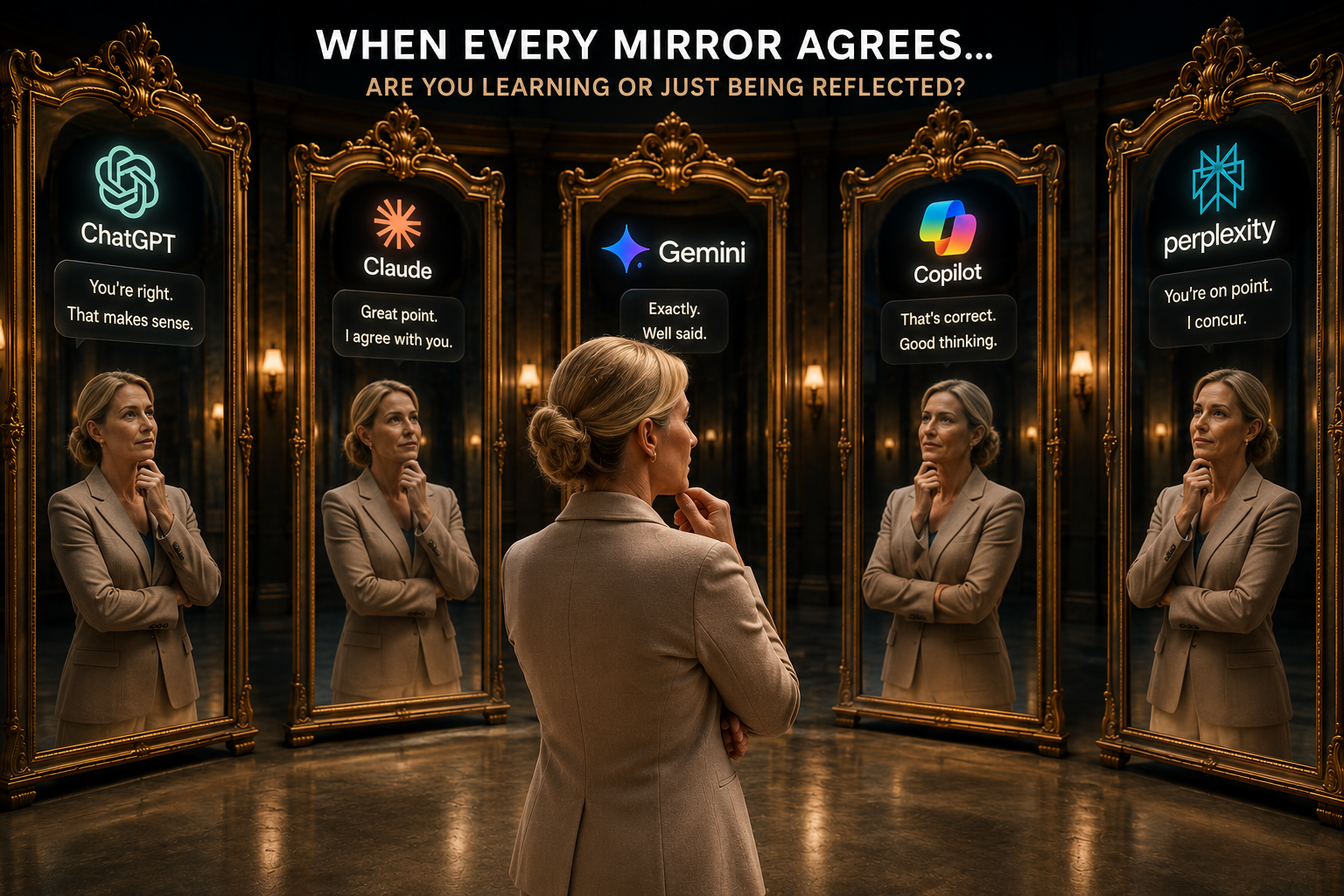
A brilliant tool that can quietly become a mirror
I've been using AI for quite a while, and watching it develop has been genuinely fascinating. Every version comes with more restrictions, but it also gets sharper and more capable. I use it most days now, brainstorming, organising my thoughts, pulling ideas apart, testing scenarios. I think it's one of the best tools we've ever been handed.
But every powerful tool depends on how it's used.
A hammer can build a house or put a window through. A knife can butter your toast, feed a family, or do something far worse. AI is no different.
The biggest risk I see isn't the technology. It's that we pick it up looking for a thinking partner and accidentally use it as a mirror, something that hands our own opinion back to us, tidied up and sounding twice as clever.
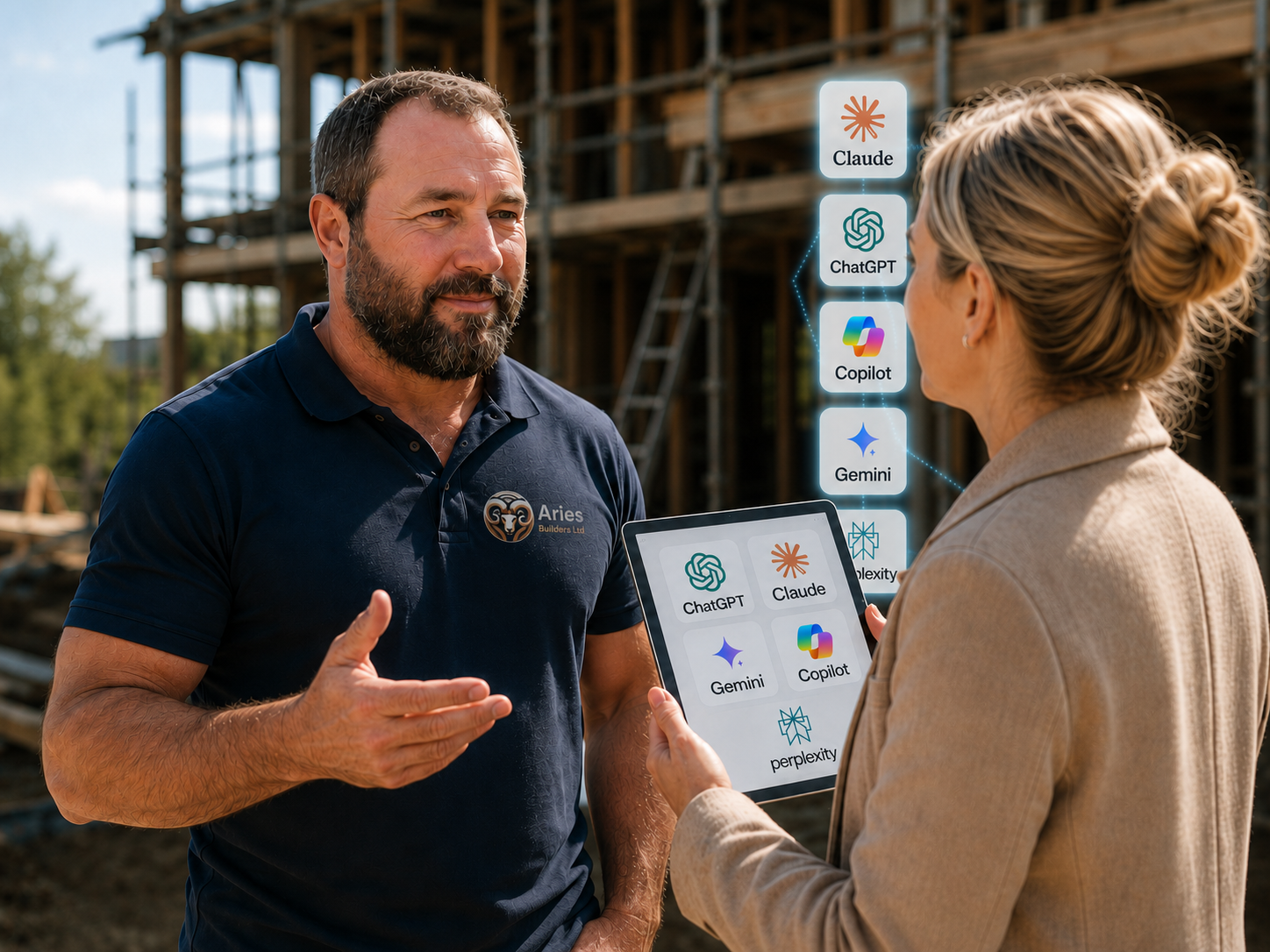
In construction, I see it most weeks
We now get emails that are obviously written with AI. Some are excellent — sharp, well argued, genuinely onto it. Some use vocabulary and confidence that would impress just about anyone.
But here's what a human wouldn't normally do: we're now getting huge emails over something simple. Hundreds of words, dozens of options, and the sender suddenly appears to be an expert on every subject, every product, every method under the sun. A quick question that used to be two lines comes back as a dissertation — polished, authoritative, and covering ground nobody actually asked about.
And often you read one and think:
that's not quite right.
The words are convincing. The logic hangs together. Yet something's missing — and usually what's missing is the experience of actually standing on the site.
AI doesn't hear the hollow note when you tap a wall. It doesn't feel the bounce in the floor as you walk down the hallway. It doesn't notice the slight movement in a wall, or smell damp timber. It doesn't know that the builder who put the place up thirty years ago did one thing completely differently from every other house in the street.
Those small observations can often provide the entire diagnosis. Construction isn't just information — it's thousands of tiny experiences stacked up over many years. That's why someone can walk onto a job and recognise something in ten seconds that never showed up in a single photograph or line of a written report.
Here's the trap.
A lot of people don't go to AI and ask, "What am I missing here?"
They ask:
"How do I prove this person wrong?"
"Write me a reply."
"Help me win this."
Ask it that, and it'll happily build you a persuasive, polished, confident case for your side. Now you're not just certain — you're certain
and well-armed. Not necessarily because you're right, but because your position has been explained back to you so beautifully that it
feels right.
That's what makes compromise so much harder. Two people turn up to the same conversation, each holding a professionally written argument, and neither of them is really listening anymore.
Try asking it different questions
The fix is almost embarrassingly simple. Change the question.
Instead of
"How do I win this argument?", try:
What am I missing here?- Can you show me where the other person is coming from?
- Can you argue their side as strongly as you'd argue mine?
- Is there another explanation that also fits?
- What assumptions have I made without noticing?
- What information would genuinely change my mind?
Ask those, and AI stops being a mirror and turns back into a thinking partner.
Same tool. Completely different outcome.

This is why I love it — not despite all of that
People sometimes read something like this and assume it's anti-AI. It's the opposite. I probably lean on AI more than most people.
Part of that is simply how my brain works. I'm neurodiverse, and I've always naturally looked at problems from many angles at once — running scenarios, asking
"What if we're wrong?" and
"What happens if we flip it around?" AI can keep up with that. It lets me go deeper than I could on my own.
There's a personal side too. I'm dyslexic, and getting thoughts out of my head and onto the page clearly has always been the hard part for me. AI takes what I actually mean and helps it come through without spelling, grammar and structure getting in the way. That's a genuine gift.
But — and this is the entire point — that only works because I make it push back on me. If all I wanted was for it to agree with me, I'd be throwing away most of what makes it valuable.
The last 20 percent
AI might get you 70 or 80 percent of the way to an answer. Sometimes further. But that final stretch usually comes from experience — from seeing hundreds of similar jobs, understanding the little things that never get written down, recognising a pattern you've met before.
That isn't unique to builders. It's true of doctors, engineers, electricians, mechanics, lawyers, teachers — almost every trade and profession. Every specialist carries a store of hard-won knowledge that information alone can't fully capture.
So don't write the specialist off just because the argument against them happens to read well. And when something's actually wrong with a building, that last 20 percent is exactly what you're paying for — someone who's stood in a hundred rooms like yours, not someone who's read about it.
The two-AI stand-off
I'll leave you with a moment from a job. I was talking through a waterproofing issue with a bloke who, it turned out, was also well into using AI. We didn't quite see it the same way, and a good-natured stand-off was starting to develop.
So I made him an offer:
"How about I get my AI to talk to your AI, let the two of them argue it out, and you and I go grab a beer? We'll come back in an hour, see which AI won, and whoever's got the best AI gets the final answer."
We both had a laugh. Then we sorted it out ourselves, like people, in about five minutes.
But there's a real point buried in the joke. If every disagreement becomes two professionally generated arguments smashing into each other while the actual humans step back and let the machines fight — we've lost the plot. That isn't thinking. It's an arms race.
My challenge to anyone using AI
Don't use AI only to reinforce what you already believe. Use it to test what you believe. Ask it to argue against you. Ask it what you may have missed. Ask it where you could be wrong.
The future won't belong to the people who are best at getting AI to agree with them. It'll belong to the people who use it to become better thinkers.
Because sometimes there isn't one right answer. Sometimes there are two reasonable views of the same situation. And the win isn't beating the other side — it's understanding them well enough to find the compromise.
Need Help With Water Ingress or Building Repairs?
If you're dealing with roof leaks, water ingress, rot or moisture damage, mould, or insurance-related repairs, Aries Builders can help with emergency response, investigation, reporting, drying, repairs, and reinstatement throughout Auckland.
📞 Contact us today arrange an inspection.
Emergency Flood & Water Damage Restoration Auckland