
Granny Flat
What You Need to Know.
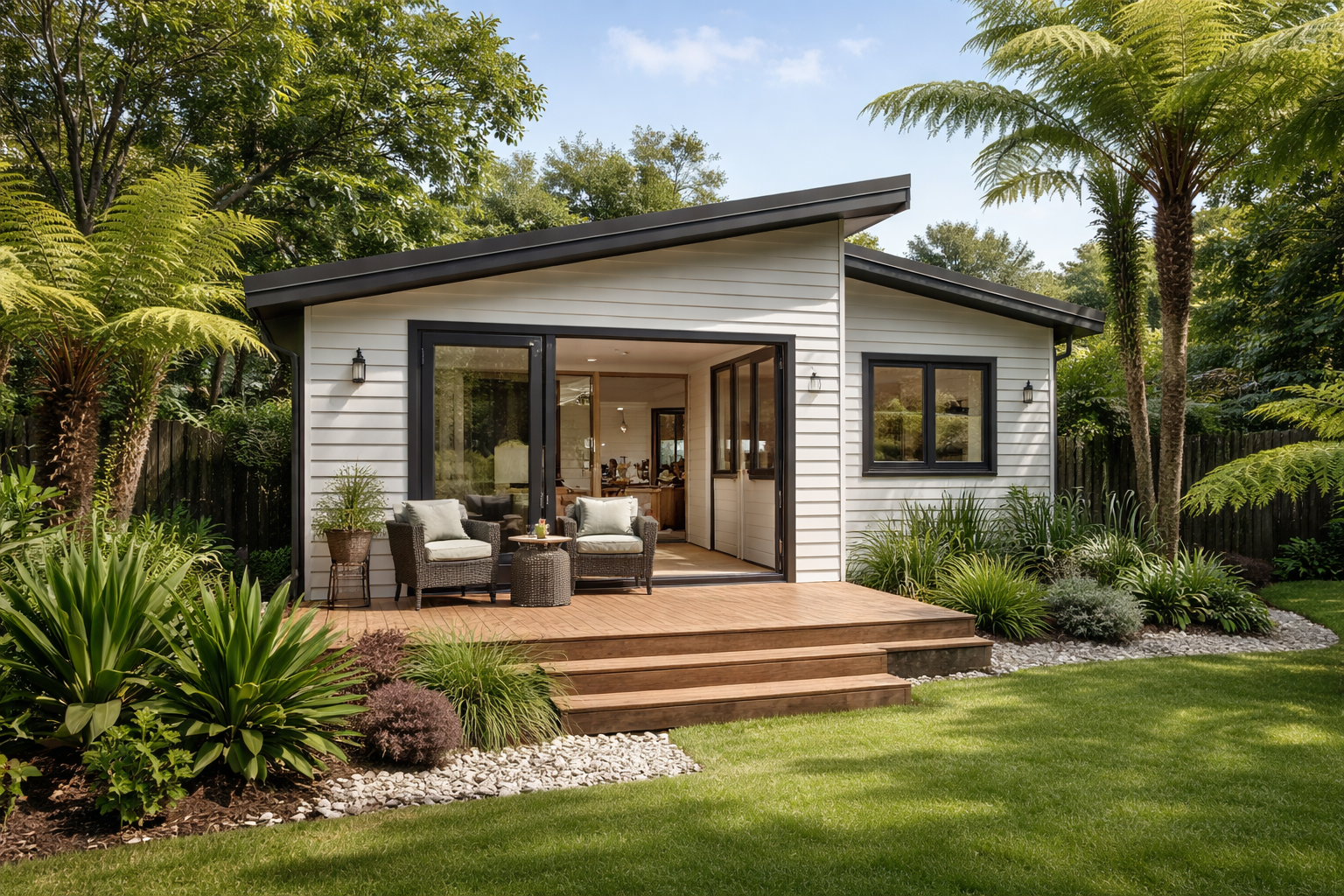
Building a Granny Flat
Trusted guidance from Aries Builders
Breaking change: New New Zealand legislation now allows standalone granny flats of up to 70 square metres to be built without a building consent — a major simplification aimed at unlocking more housing options and reducing regulatory red tape. Building Performance+1
Whether you’re planning a space for family, or simply more flexibility in how you use your land, this change makes things easier — but it’s still important to get the details right.
Rough Build Cost Calculator (Guide Only)
Use this quick calculator to get a ballpark build cost based on floor area (m²) and a general finish level. This is not a quote — it’s a rough guide to help you sense-check budgets before plans, engineering, and site specifics are confirmed.
Optional: add a contingency allowance
Enter an area to see an estimate.
What’s often extra (not always included in $/m² guides)
- Utility connections(power, water, telecom) and upgrades to existing services
- Landscaping & driveways(excavation, retaining, paving, turf, planting, fencing)
- Window treatments(blinds/curtains)
- Furniture & décor(appliances, loose items, styling)
- Council fees / consenting costs where applicable (e.g., building consent, development contributions, inspections)
- Site-specific costs(difficult access, steep sites, poor ground, drainage needs, demolition, asbestos, temporary works)
Important note
These figures are indicative only. The real cost can move significantly depending on design complexity, structural requirements, site conditions, product selections, and timeframes. For accurate pricing, we recommend progressing from ballpark figures to concept plans, then a detailed scope and quote once selections are confirmed.
Important: What the Exemption Doesn’t Change
Planning & Resource Consents
The exemption only affects building consents. It does not automatically change:
- District plan rules (setbacks, site coverage, height limits)
- Resource consent requirements under planning laws
- Overlay or natural hazard rules
This means you may still need planning or resource consents if your site doesn’t meet the local rules. Building Performance
You must check your district plan and speak with your council early.
Can You Rent a Granny Flat Built Under the Exemption?
Yes — building consent exemptions do not prohibit renting.
What matters for renting is a different set of rules:
✔ If you decide to rent the granny flat, it must comply with:
- Residential Tenancies Act (rights and responsibilities)
- Healthy Homes Standards (insulation, heating, ventilation, moisture control)
- Any other landlord requirements when you operate a rental property
The exemption simply removes the need for a building consent — it does not affect tenancy law. NZ Legal
Note: Local councils may have planning rules about whether a secondary dwelling can be used as a rental — so check with them first.
Core Exemption Conditions You Must Meet
To build without a building consent, your granny flat must:
Size & Design
- Be standalone (not physically part of another dwelling)
- Have a net floor area ≤ 70 m²
- Be single-storey with a simple design
- Comply with all applicable Building Code requirements (durability, fire safety, moisture control, accessibility, etc.) Building Performance
Licensed Building Professionals
All building work must be carried out or supervised by the appropriate licensed professionals, including:
- Licensed builders (LBPs)
- Licensed plumbers and drainlayers
- Licensed electricians
- Licensed gasfitters (if gas services are used)
You must collect Records of Work (RoW) and other certificates from all trades and submit them to council.Building Performance
Council Notifications
You must notify your local council:
- Before you start building
- After the granny flat is completed and all documentation (RoWs, certificates, plans) is ready Building Performance
Councils use this notification to confirm compliance and to collect development contributions.
Plumbing, Electrical & Other Services
Even though you don’t need a building consent, you do need to comply with specific requirements for:
Plumbing and Drainage
- Must be done by a licensed plumber or drainlayer
- Must meet the Building Code clauses for sanitary installations and drainage
- Records of Work must be provided and submitted to the council Licensed Building Practitioners
Electrical
- Must be done by a licensed electrician
- Electrical safety certificates and records of work must be submitted
Gas & Other Services
- Licensed specialists must handle gas fitting
- Appropriate gas safety certificates and RoWs apply
The exemption doesn’t change these requirements — it just lets you do it without a building consent, but the safety and compliance standards still apply. Licensed Building Practitioners
Timing & Getting the Ball Rolling
When It Starts
The exemption comes into effect once the regulations are in force — expected early 2026, around 15 January 2026. Building Performance
What You Should Do Now
Even if your build isn’t immediate, it’s smart to:
- Start planning now
- Talk to designers and builders
- Check your local council’s district plan
- Understand service connections (water, wastewater, power)
- Consider rental use if that’s part of your plan
Good early planning helps avoid delays later.
Why Work With Aries Builders
We provide more than construction — we offer guidance and clarity:
✔
We understand the 2026 exemption and what it really means
✔
We help you check planning rules and council requirements
✔We coordinate licensed professionals and compliance paperwork
✔We scope work carefully so there are no surprises
✔ We keep communication clear and expectations realistic
We’re here to help you build confidently — and correctly.
Helpful Links You Can Use
Official Granny Flats Building Consent Exemption Guidance
https://www.building.govt.nz/projects-and-consents/planning-a-successful-build/scope-and-design/check-if-you-need-consents/building-work-that-doesnt-need-a-building-consent/granny-flats-exemption-guidance-and-resources
Building Performance
Government Media Release on the Legislation
🔗https://www.beehive.govt.nz/release/granny-flats-get-consent-free-go-ahead
The Beehive
Let’s Talk Next Steps
Whether you want to plan your build, check your site’s rules, or simply get a rough idea of costs and timing, we’re here to help.
A short conversation now can make your project smoother later.
Aries Builders
Professional advice. Friendly guidance. Built right.
Auckland-Specific FAQs – Granny Flats (Auckland, 2026)
How close to the boundary can I build a granny flat in Auckland?
In Auckland, boundary setbacks are controlled by the Auckland Unitary Plan, not the building consent exemption.
For most residential zones, typical rules are:
- Minimum setback:
Often 1 metre from side and rear boundaries - Front yards:
Usually 3–5 metres, depending on zone
However, setbacks vary depending on:
- Your zoning (Mixed Housing Suburban, Urban, Single House, etc.)
- Whether the wall is fire-rated
- Building height and orientation
If a granny flat does not meet setback rules, a resource consent may be required — even if no building consent is needed.
What are Auckland’s height limits for granny flats?
Height limits are set by the Auckland Unitary Plan and vary by zone.
Typical limits are:
- Single House Zone: up to 8 metres
- Mixed Housing Suburban: up to 8 metres
- Mixed Housing Urban: up to 11 metres
- Granny flats under the exemption are generally single storey
Height-to-boundary controls also apply, meaning:
- The closer you build to a boundary, the lower the allowed height
- This protects neighbours’ sunlight and outlook
Are there rules about blocking sunlight or shading neighbours in Auckland?
Yes.
Auckland uses height-to-boundary recession planes to control:
- Overshadowing
- Loss of daylight
- Visual dominance
In simple terms:
- Buildings must “slope away” from boundaries at a defined angle
- Taller walls must be further away from boundaries
- North-facing boundaries are more sensitive due to sunlight access
If your design blocks sunlight beyond what’s permitted, resource consent may be required.
Can I build a granny flat right next to a fence in Auckland?
Usually no, unless:
- The design meets fire-separation rules
- The wall is specifically fire-rated
- Planning rules allow reduced setbacks
- A resource consent is obtained
Fire separation is governed by the NZ Building Code, regardless of the exemption.
Does Auckland allow granny flats to be rented?
Auckland Council generally allows secondary dwellings to be rented, subject to planning rules.
However, rental use depends on:
- Zoning
- Site layout
- Infrastructure capacity
- Compliance with Healthy Homes Standards
The building consent exemption does not restrict renting, but planning rules still apply.
Short-term rentals (Airbnb-style use) may have additional restrictions.
Do I still need to notify Auckland Council if there’s no building consent?
Yes.
Under the exemption you must:
- Notify Auckland Council before construction
- Provide completion documentation after the build, including:
- Records of Work from LBPs
- Plumbing and electrical certificates
- Final plans
Auckland Council also uses this information to:
- Update property records
- Assess development contributions
- Confirm infrastructure capacity
Do development contributions apply in Auckland?
Yes — in many cases.
Even without a building consent, Auckland Council may charge development contributions for:
- Additional dwellings
- Increased demand on infrastructure (water, wastewater, transport)
This is separate from the building consent process.
Can I build a granny flat on a cross-lease property in Auckland?
Cross-lease properties are more complex.
You may need:
- Written approval from other owners
- A new flats plan
- Legal advice before building
The building consent exemption does not override cross-lease title requirements.
Can I build a granny flat in a flood zone or special area in Auckland?
Possibly — but extra checks are required.
Additional rules apply if the site is in:
- Flood plains
- Coastal inundation zones
- Volcanic or hazard overlays
- Special character areas
In these cases, a resource consent may still be required.
What Auckland zones most commonly allow granny flats?
Granny flats are commonly feasible in:
- Single House Zone
- Mixed Housing Suburban
- Mixed Housing Urban
Each zone has different limits on:
- Site coverage
- Height
- Yard setbacks
- Number of dwellings
Site-specific checks are essential.
What’s the smartest first step in Auckland?
Before spending money on design:
- Confirm zoning
- Check yard setbacks and height rules
- Confirm services capacity
- Clarify rental intentions
- Talk to a builder who understands both planning and buildability
Early advice prevents redesigns, delays, and unexpected costs.
| Auckland Zone | Granny Flats Generally Allowed | Typical Height Limit | Typical Side / Rear Setback | Notes |
|---|---|---|---|---|
| Single House Zone | Yes | Up to ~8 metres | ~1 metre | Lower density, stricter controls |
| Mixed Housing Suburban | Yes | Up to ~8 metres | ~1 metre | Most suburban areas |
| Mixed Housing Urban | Yes | Up to ~11 metres | Often reduced | Greater flexibility |
| Terraced Housing & Apartment | Sometimes | Up to ~16 metres+ | Varies | Site-specific assessment required |
| Large Lot / Rural Residential | Yes | Varies | Larger setbacks | Services often determine feasibility |
| Distance from Boundary | Typical Maximum Wall Height |
|---|---|
| At boundary | ~2.5 metres |
| 1 metre from boundary | ~3.5 metres |
| 2 metres from boundary | ~4.5 metres |
- Up to 70 m² may be built without a building consent from 15 January 2026
- Auckland planning rules still apply
- Boundary setbacks, height limits, and shading controls must be met
- Renting is allowed if planning rules permit
- Council notification and licensed trades are still required
Granny Flat Cost Guide — Auckland (2026)
With the new granny flat exemption now in effect from 15 January 2026, you can build a standalone secondary dwelling up to 70 m² without a formal building consent — as long as it meets the Building Code and is built by licensed professionals.
While removing the consent requirement helps reduce regulatory steps, the cost to build still depends on design choices, site conditions, and finishes you choose. Below is a helpful guide to give you a realistic budget range for planning:
Rough Build Cost per Square Metre (Indicative)
•
Standard finishes: ~NZD 2,500 – 3,500 per m²
•
Mid-range quality: ~NZD 3,500 – 4,500 per m²
•
High-end finishes & bespoke design: ~NZD 4,500 – 6,000+ per m²
What This Means in Practice
For example, a
60 m² granny flat built with mid-range finishes could typically sit around
$210,000 up $360,000+ for
High-end finishes, all inclusive of labour and basic materials. Larger units closer to the 70 m² limit or those with premium fixtures and features will sit toward the higher part of the range.
Other Costs to Consider
• Site preparation — groundworks, drainage, retaining walls
• Utility connections — water, wastewater, power, internet
• Auckland Council development contributions (may apply)
• Design, engineering, or architectural support
Even though a building consent isn’t required under the new exemption, you still must comply with planning rules, notify Auckland Council before and after construction, and engage licensed trades for all regulated work.
Want a More Accurate Estimate?
We’re here to help you refine these numbers for your site and project vision. Get in touch for a friendly consultation and a tailored cost breakdown that takes your specific design and project goals into account.